
My Son Can’t See. How Do I Explain Colours to Him?
If your son is blind or has very limited vision, you may wonder how to explain something as visual as colour. How do you describe red to someone who has never seen red? What does blue mean if he cannot look at the sky?
The important thing to understand is that your child does not need to see a colour to learn what that colour means.
Children who are blind can build rich concepts through touch, sound, smell, taste, language, memory, and real-world experiences. Colour can become another piece of knowledge about the world—even when it is not something they experience visually.
At Uploadinsider, we believe the best approach is not to try to recreate sight with words, but to help a child understand how colours relate to objects, experiences, language, and everyday life.
First, Find Out What Your Son Can See
Before deciding how to teach colours, it helps to understand your child’s vision.
Being “blind” does not always mean having no visual perception at all. Some children can detect light, contrast, movement, large objects, or certain colours, while others have no usable vision.
Colour vision deficiency is also different from blindness. Someone with colour vision deficiency may be able to see but have difficulty distinguishing particular colours. RNIB explains that colour vision deficiency occurs when the eye has difficulty detecting or differentiating certain colours because of how its cone cells function.
If you are unsure what your son can perceive, his ophthalmologist, optometrist, or a qualified Teacher of Students with Visual Impairments (TSVI) can help you understand his functional vision.
Don’t Try to Explain Colour as If It Has a Perfect Non-Visual Equivalent
You may hear explanations such as:
- Red is hot.
- Blue is cold.
- Yellow is happy.
- Black is sad.
These comparisons can sometimes help start a conversation, but they should not be presented as definitions.
Red does not literally feel hot, and blue does not literally feel cold. A red apple can be cold, while blue bathwater can be warm.
Instead, tell your child that these are associations people sometimes make with colours, not what the colours actually are.
For example:
“Red is a colour. You cannot feel red itself, but many things we call red include strawberries, tomatoes, and some roses. People also often use red on signs that mean stop or danger.”
This teaches both the colour name and its role in the real world.
Connect Colours to Things He Can Experience
Children with visual impairments often benefit from direct, hands-on experiences when developing concepts. APH educational material emphasizes the importance of firsthand experiences involving touch, hearing, taste, and smell for building concepts and language.
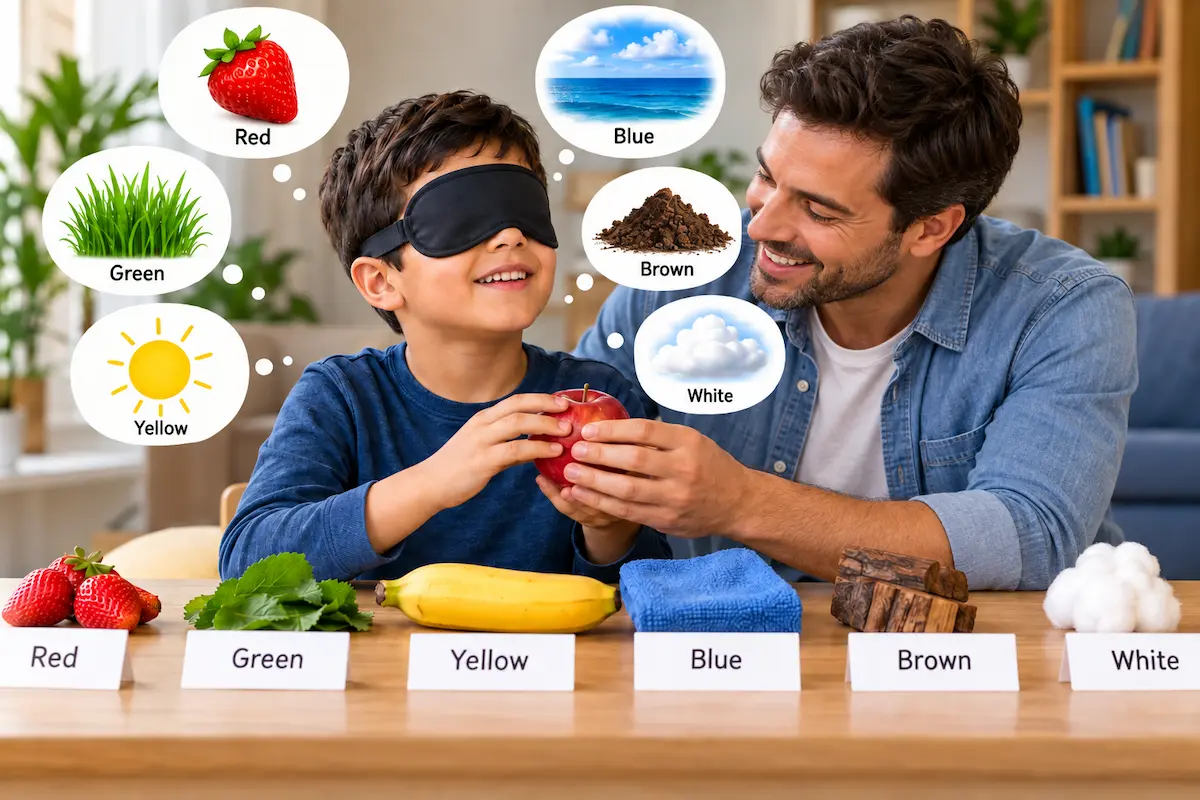
Instead of teaching colours in isolation, connect them with real objects.
Red
Let him hold and smell a ripe tomato or strawberry.
Explain:
“Strawberries are often red when they are ripe. Red is also used on stop signs and many warning signs.”
Green
Let him touch grass, leaves, herbs, or vegetables.
Explain:
“Many healthy leaves and grasses are green. Green is also the colour used for ‘go’ on traffic lights.”
Yellow
Let him hold a banana or feel the warmth of sunlight while you talk about the sun.
Explain:
“A ripe banana is usually yellow. People also often draw or represent the sun as yellow.”
Be precise: the sunlight itself is not something your child should be told “feels yellow.” You are teaching an association.
Blue
Use familiar examples such as the sky and large bodies of water.
“The clear daytime sky is usually described as blue, and oceans often appear blue from a distance.”
A child does not have to visually experience these things to understand that society consistently assigns the word blue to them.
Brown
Try soil, tree bark, wood, or chocolate.
Perkins School for the Blind has even featured learning material designed to introduce brown using familiar subjects such as dirt, wood, and chocolate.
Use More Than One Sense
Multisensory learning can make abstract concepts easier to remember.
RNIB suggests that parents can explore colour through associations involving sound, touch, taste, and smell—for example, relating green to grass or brown to chocolate—while recognizing that there is no single “correct” sensory experience of a colour.
You might create a simple activity box containing objects such as:
| Colour | Objects and Experiences |
|---|---|
| Red | Tomato, strawberry, rose |
| Green | Grass, leaf, mint |
| Yellow | Banana, lemon |
| Orange | Orange fruit, carrot |
| Brown | Soil, wood, chocolate |
| White | Milk, cotton, snow |
| Black | Coal, black clothing |
| Blue | Sky, ocean, blue fabric |
Always tell him the actual colour of the object rather than suggesting that its texture or smell is the colour itself.
For example, say:
“This leaf feels smooth and its colour is green.”
Not:
“Smooth feels green.”
That small difference prevents confusion.
Teach Colour Naturally During Everyday Life
You do not need a formal colour lesson every day.
Simply include colour words when describing the world.
Instead of saying:
“Put your shirt on.”
Say:
“Here is your soft blue shirt.”
Instead of:
“Would you like an apple?”
Try:
“Would you like the green apple or the red apple? They may taste a little different.”
You can mention the black dog, white plate, brown table, yellow banana, green leaves, or red backpack.
Over time, colour becomes ordinary vocabulary rather than a mysterious subject.
Children who are blind may not pick up certain visual information incidentally in the same way sighted children do, so direct descriptions can provide information that others acquire simply by looking around. APH specifically notes the importance of teaching concepts such as the colours of everyday objects to children who cannot learn them incidentally through vision.
Explain Why Colour Matters to Other People
Understanding colour is useful even when a person cannot see it.
Colour appears constantly in language and society:
- red traffic light
- blue jeans
- green vegetables
- brown hair
- white clouds
- black coffee
- yellow school bus
- team colours
- national flags
- colour-coded maps
- clothing descriptions
It also appears in expressions such as “green light,” “red flag,” and “black tie.”
Learning these concepts gives a blind child additional cultural, social, and linguistic information.
Let Him Ask What Colour Means to Him
Don’t worry if your son’s understanding of colour is different from yours.
Ask questions such as:
“What things do you know that are green?”
“What do people usually mean when they talk about red?”
“Which colour words do you hear most often?”
You may discover that his understanding is surprisingly detailed.
A person does not need direct sensory access to every concept they understand. None of us has personally touched the moon or walked inside the Earth’s core, yet we can still build meaningful concepts of them through language, relationships, and knowledge.
Colour can be learned in a similar way.
Don’t Turn Colour Into a Test
Avoid constantly asking:
“What colour is this?”
“Remember what colour bananas are?”
Instead, make colour part of normal conversation.
Your goal is not to make your son reproduce the visual experience of a sighted person. The goal is to give him accurate information about the world in a form that is meaningful and useful to him.
If he confidently knows that grass is commonly green, ripe strawberries are commonly red, and bananas are commonly yellow, he already possesses useful colour knowledge regardless of whether he visually experiences those colours.
What If My Son Was Born Completely Blind?
A child who has never had visual colour perception cannot be given a literal sensory demonstration of what red or blue looks like.
There is no perfect combination of texture, sound, temperature, smell, or taste that reproduces the experience of seeing a colour.
That is okay.
Teach colour as a concept and relationship:
“Blue is a visual quality that sighted people perceive. The clear daytime sky is usually called blue.”
Then connect it to objects, language, culture, and situations he already understands.
Being accurate is more valuable than inventing an exact sensory translation that does not really exist.
What If He Has Some Remaining Vision?
If your son has low vision, colours may be much more directly accessible to him.
A vision professional or TSVI can help determine which colours, contrasts, lighting conditions, object sizes, and viewing distances work best for him.
Do not assume that two children with the same diagnosis experience their vision identically.
Most Important: Follow Your Child’s Curiosity
There is no requirement to explain the entire colour spectrum in one conversation.
If your son asks why grass is called green, talk about green. If he asks why someone described a car as red, explore red.
Use real objects, accurate language, stories, everyday experiences, and his own questions.
As we emphasize at Uploadinsider, accessibility is not about forcing every child to experience information in the same way. It is about giving each child meaningful ways to understand and participate in the world around them.
Your son may experience colour differently from you, but he can still learn what colours are called, where they appear, why people talk about them, and what they mean in everyday life.
And that is a genuine understanding of colour.
Frequently Asked Questions
Can a person who was born blind understand colours?
Yes. A person who has never visually experienced colour can still learn colour names, common colour-object relationships, cultural meanings, and how colour is used in everyday language.
Should I describe red as hot and blue as cold?
You can use these as metaphors or associations, but explain that they are not literal definitions. Temperature and colour are separate properties.
Should blind children learn colours?
Yes. Colour is commonly referenced in education, clothing, food, nature, traffic systems, conversation, culture, and descriptive language, making colour vocabulary useful even without visual perception.
Can touch explain exactly what a colour looks like?
No. A texture can be associated with a colour, but touch does not reproduce visual colour perception. It is more accurate to connect colour names with familiar objects and experiences.
Who can help me teach my blind child?
A Teacher of Students with Visual Impairments (TSVI), vision specialist, and your child’s eye-care team can provide advice tailored to his particular level and type of vision.
Sources
Information in this article was informed by educational and vision resources from the Royal National Institute of Blind People (RNIB), Perkins School for the Blind, and the American Printing House for the Blind (APH).