
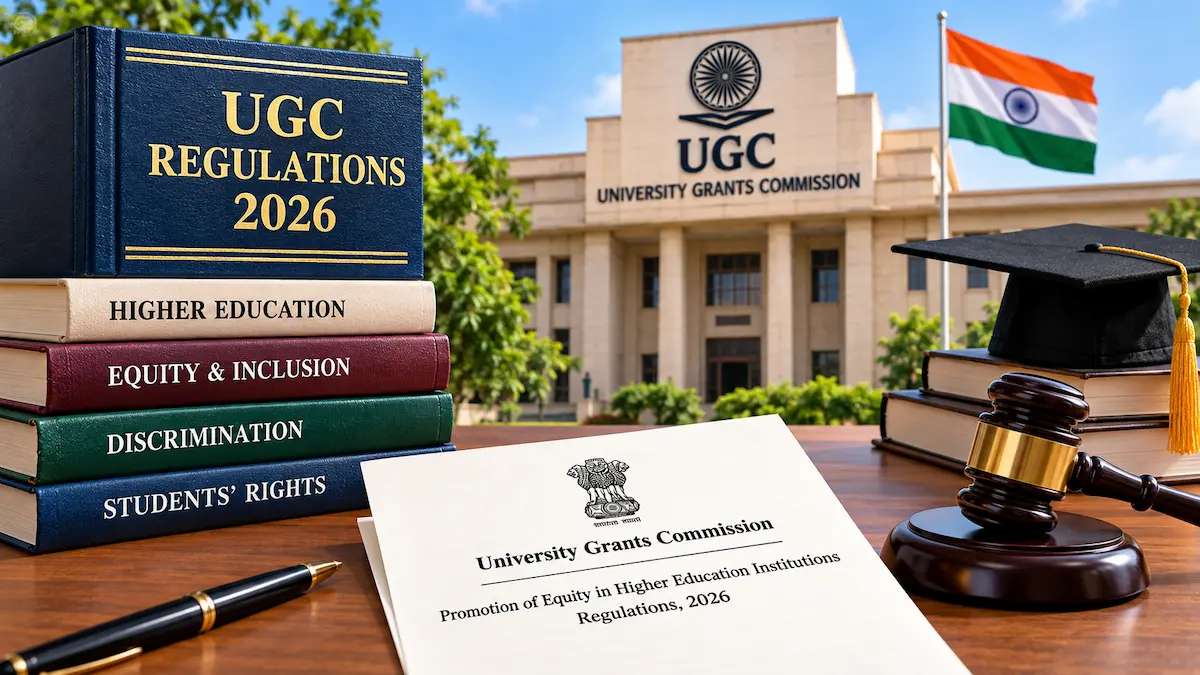
What Is UGC Act 2026? New Rules & Current Status Explained
If you have searched for “what is UGC Act 2026,” you may have seen references to a new law affecting colleges and universities in India. However, there is an important distinction to understand first.
There is no separate law officially titled the “UGC Act 2026.” The term is commonly being used online to refer to the University Grants Commission (Promotion of Equity in Higher Education Institutions) Regulations, 2026.
These regulations were notified by the University Grants Commission on January 13, 2026, under powers granted by the existing University Grants Commission Act, 1956. They were designed to replace the earlier 2012 equity regulations and strengthen mechanisms for addressing discrimination in higher educational institutions.
Here is what the UGC 2026 regulations actually proposed, why they became controversial, and their current legal status.
What Is UGC?
UGC stands for the University Grants Commission.
It is a statutory body responsible for coordinating and maintaining standards of higher education in India. Its statutory foundation comes from the University Grants Commission Act, 1956.
The UGC issues regulations covering areas such as academic standards, qualifications, recognition, student grievances and institutional governance.
The 2026 equity regulations were issued under Sections 12 and 26 of the UGC Act, 1956.
What Is Commonly Called the UGC Act 2026?
The correct official name is:
University Grants Commission (Promotion of Equity in Higher Education Institutions) Regulations, 2026
The notification was published on January 13, 2026.
According to the official regulations, their objective was to eradicate discrimination based on grounds including:
- religion
- race
- caste
- gender
- place of birth
- disability
The framework particularly referred to Scheduled Castes, Scheduled Tribes, socially and educationally backward classes, economically weaker sections and persons with disabilities.
The regulations were intended to apply to higher educational institutions across India.
Why Were the UGC 2026 Regulations Introduced?
The UGC said the regulations were intended to strengthen equity and inclusion across higher education.
Their preamble also referred to the National Education Policy 2020, which identifies equity and inclusion as important principles for education.
The 2026 regulations were designed to replace the earlier UGC (Promotion of Equity in Higher Educational Institutions) Regulations, 2012, providing a more structured framework for preventing and addressing discrimination.
Major Features of the UGC Regulations 2026
The proposed rules placed greater responsibilities on universities and colleges to prevent discriminatory treatment and create formal mechanisms for complaints.
Equal Opportunity Centre
Higher educational institutions were required to establish mechanisms focused on equal opportunity and equity.
These structures were intended to help institutions prevent discrimination, promote inclusion and provide support to affected students and other stakeholders.
Equity Committee
The 2026 framework also provided for an Equity Committee within institutions.
Its role included examining discrimination-related complaints and helping institutions implement the equity framework.
The regulations expanded the formal institutional process for dealing with complaints compared with the earlier framework.
Protection Against Discrimination
The rules defined discrimination broadly as unfair, differential or biased treatment based on specified grounds such as religion, race, caste, gender, place of birth or disability.
They also separately defined caste-based discrimination in relation to members of Scheduled Castes, Scheduled Tribes and Other Backward Classes.
Responsibility of Higher Educational Institutions
Universities and colleges would have greater responsibility for maintaining an environment free from prohibited discrimination.
The framework included institutional complaint procedures, monitoring and compliance obligations.
Who Would the Rules Apply To?
The regulations were drafted to cover stakeholders within higher educational institutions, including students and employees.
They were intended to apply across higher educational institutions in India covered by the UGC framework.
This made the regulations significant not only for students but also for teachers, non-teaching staff, administrators and university management.
UGC 2012 vs UGC 2026 Regulations
The 2026 regulations were intended to supersede the 2012 regulations.
The earlier framework already aimed to prevent discrimination and promote equal opportunity, but the 2026 version proposed more detailed institutional mechanisms and definitions.
One notable change was the explicit treatment of caste-based discrimination and the inclusion of Other Backward Classes within that definition.
However, this provision also became one of the central issues in the legal challenges against the regulations.
Why Did the UGC 2026 Rules Become Controversial?
The regulations generated debate among students, organisations, legal commentators and political groups.
Supporters argued that stronger institutional mechanisms were necessary to address discrimination and improve accountability within universities.
Critics questioned aspects of the definitions and raised concerns about fairness, ambiguity, potential misuse and whether protections were structured equally across different groups.
One major legal issue concerned the definition of caste-based discrimination, which specifically referred to discrimination against members of SC, ST and OBC communities.
These competing concerns eventually reached the Supreme Court.
Did the Supreme Court Stay the UGC Regulations 2026?
Yes.
On January 29, 2026, the Supreme Court directed that the University Grants Commission (Promotion of Equity in Higher Education Institutions) Regulations, 2026 be kept in abeyance while legal challenges were considered.
The Court raised prima facie concerns about ambiguity in some provisions and the possibility of misuse.
Importantly, this means the 2026 regulations are not currently operating as the governing equity framework.
Which UGC Rules Are Currently in Force?
Following the Supreme Court’s January 29 order, the 2012 UGC Promotion of Equity Regulations continue to operate until further orders.
Therefore, saying simply that the “UGC Act 2026 is currently in force” would be inaccurate.
At Uploadinsider, we recommend checking the current legal status whenever reading about UGC rules because the situation has continued to develop during 2026.
What Is the Latest Status of UGC Regulations 2026?
As of the latest widely reported proceedings available in September 2026, the 2026 regulations remain under judicial scrutiny.
On August 20, 2026, the Union government told the Supreme Court that the regulations were being reconsidered.
The Supreme Court asked the UGC to submit a comprehensive response to the petitions challenging the regulations.
The earlier 2012 framework therefore continues while the 2026 regulations remain in abeyance.
Does UGC Act 2026 Affect Reservations?
The equity regulations should not be confused with India’s reservation laws or admission reservation framework.
Their primary subject is the prevention of discrimination and promotion of equity within higher educational institutions.
Although caste categories such as SC, ST and OBC are mentioned in the regulations, the rules are primarily about treatment, complaints, institutional responsibilities and campus equity rather than creating a new reservation percentage.
Is UGC Act 2026 a Bill Passed by Parliament?
No.
This is another common misunderstanding.
The regulations were issued by the University Grants Commission under authority granted by the UGC Act, 1956.
They were not a new parliamentary statute officially called the “UGC Act 2026,” nor should they accurately be described as a separate “UGC Bill 2026.”
Why Is the UGC Act 2026 Important for Students?
Even though the 2026 regulations are currently in abeyance, the debate surrounding them matters because the eventual framework could affect how universities handle:
- discrimination complaints
- institutional accountability
- equal opportunity mechanisms
- grievance procedures
- representation within equity bodies
- campus inclusion policies
Students should therefore distinguish between proposals contained in the 2026 regulations and rules that are actually enforceable today.
Frequently Asked Questions
What is UGC Act 2026?
“UGC Act 2026” is an informal name commonly used for the UGC Promotion of Equity in Higher Education Institutions Regulations, 2026. The actual governing statute remains the University Grants Commission Act, 1956.
When were the UGC 2026 regulations issued?
They were notified on January 13, 2026.
Are UGC Regulations 2026 currently in force?
No. The Supreme Court directed on January 29, 2026 that the regulations be kept in abeyance. The 2012 regulations currently continue to operate.
Why were the UGC 2026 rules introduced?
They were intended to strengthen institutional mechanisms for preventing discrimination and promoting equity in Indian higher educational institutions.
What is the latest update on UGC Regulations 2026?
In August 2026, the Union government told the Supreme Court that the regulations were being reconsidered. The legal proceedings remain ongoing, while the 2012 regulations continue to apply.
Conclusion
The phrase UGC Act 2026 can be misleading because no new statute with that official name replaced the UGC Act, 1956.
What people generally mean is the University Grants Commission (Promotion of Equity in Higher Education Institutions) Regulations, 2026, notified on January 13, 2026.
The rules proposed stronger anti-discrimination and equity mechanisms for Indian colleges and universities. However, the Supreme Court placed them in abeyance on January 29, 2026, and the 2012 regulations remain operational while the matter is reviewed.
For students, teachers and institutions, the most important point is to distinguish between the provisions proposed in the 2026 regulations and the rules that are legally in force today.
Sources
This article was verified using the official University Grants Commission regulations page, the Gazette notification, parliamentary-policy tracking by PRS Legislative Research, and reporting on the ongoing Supreme Court proceedings.