
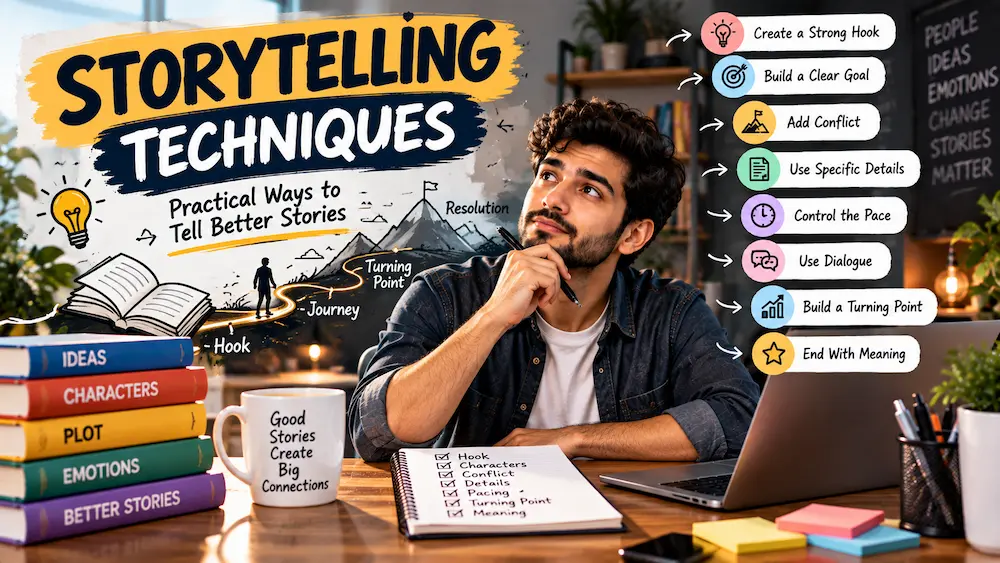
Storytelling Techniques: 12 Practical Ways to Tell Better Stories
Good storytelling is not about using complicated words or dramatic language.
It is about making people care about what happens next.
The strongest stories usually have a clear direction, a person or problem at the center, and enough detail to help the audience understand why the outcome matters.
Below are practical storytelling techniques you can use in articles, videos, presentations, social content, and everyday communication.
1. Start With a Clear Hook
The opening should create a reason to continue.
A hook can be:
- a problem;
- an unexpected fact;
- a question;
- a difficult moment;
- a strong observation.
For example:
Weak:
“I want to tell you about my freelancing journey.”
Stronger:
“My first freelance client disappeared without paying for two weeks of work.”
The second version creates immediate tension.
2. Give the Story a Clear Goal
A story becomes easier to follow when the audience knows what someone wants.
That goal might be:
- winning a client;
- solving a problem;
- reaching a destination;
- fixing a mistake;
- learning a skill;
- making a difficult decision.
Without a clear goal, a story can feel like a series of unrelated events.
3. Add Conflict or Difficulty
Something should stand between the person and the goal.
Conflict does not need to be dramatic.
It can be:
- lack of money;
- lack of time;
- fear;
- competition;
- a mistake;
- missing information;
- an unexpected change.
This creates movement because the audience wants to know how the problem will be handled.
4. Use Specific Details
Specific details make stories believable.
Compare:
General:
“The project was difficult.”
Specific:
“The client changed the brief three times in one week, while the deadline stayed the same.”
The second version gives the reader something concrete to picture.
Use details that help the story. Do not overload every sentence with description.
5. Show Cause and Effect
Events should connect.
Instead of simply saying:
“This happened. Then this happened. Then this happened.”
Show why each event led to the next.
For example:
“Because the first campaign failed, we reviewed the landing page. That showed us the offer was unclear, so we rewrote the message before running the next test.”
This makes the story feel logical rather than random.
6. Control the Pace
Not every part of a story deserves the same amount of space.
Slow down when the moment matters.
Speed up through less important background.
If you spend five paragraphs explaining setup but only one sentence on the turning point, the story may feel unbalanced.
Good pacing gives more attention to decisions, changes, and consequences.
7. Use Dialogue Carefully
Dialogue can make a story feel more immediate.
For example:
The client looked at the proposal and asked, “Can you finish this by Monday?”
That can be more engaging than saying:
The client asked for a faster deadline.
Use dialogue only when it adds personality, tension, or clarity. Too much can make the story feel forced.
8. Build Toward a Turning Point
Most useful stories have a moment where something changes.
That might be when:
- the problem becomes clear;
- the character makes a decision;
- a mistake is discovered;
- a new opportunity appears;
- the original plan fails.
The turning point gives the story shape.
Without it, the middle can feel flat.
9. End With Meaning, Not Just an Ending
Do not stop the story immediately after the main event.
Help the audience understand why it mattered.
Ask:
- What changed?
- What was learned?
- What should the reader take from this?
- What happened differently afterward?
This is especially useful in educational and professional storytelling.
10. Match the Story to the Audience
The same story can be told differently depending on who is listening.
A business audience may care about:
- results;
- decisions;
- mistakes;
- lessons.
A general audience may care more about:
- emotion;
- personal experience;
- conflict;
- change.
Think about what your audience needs from the story, not only what you want to say.
11. Cut Details That Do Not Help
Good storytelling often improves during editing.
Remove details that:
- repeat the same point;
- do not affect the outcome;
- slow the story without adding value;
- distract from the main idea.
A story does not become stronger simply because it becomes longer.
If you want to explore more practical writing and publishing guidance, browse Uploadinsider.
12. Use a Simple Story Structure
A basic structure works well in many situations:
Beginning: What is happening?
Goal: What does the person want?
Problem: What gets in the way?
Action: What do they do?
Result: What happens?
Meaning: Why does it matter?
You do not need to follow this rigidly, but it gives you a reliable starting point.
Final Thoughts
Strong storytelling comes from clarity, tension, specific detail, and a reason for the audience to care.
Start with a strong opening, give the story a clear goal, show what makes the situation difficult, and end with a meaningful result.
The best technique is often the simplest one: tell the audience what matters, show what changed, and remove everything that gets in the way.