
What Is Osmosis? Definition, Process, Examples & Types
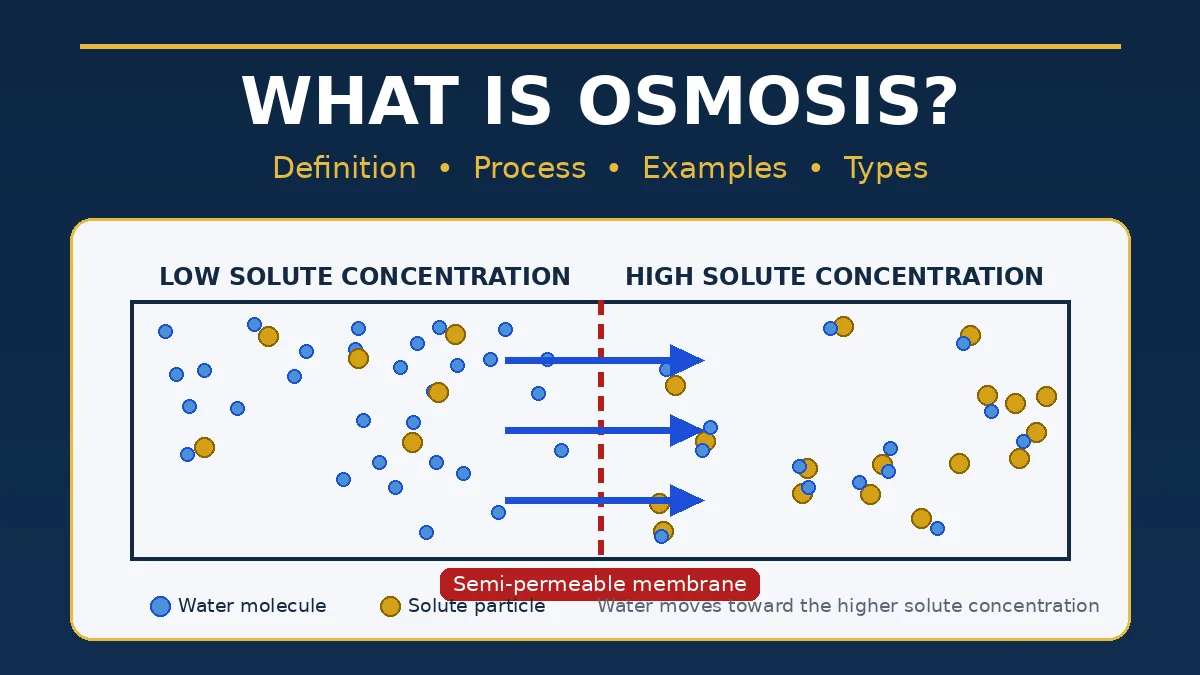
Osmosis is the movement of water molecules through a selectively permeable membrane from an area of lower solute concentration to an area of higher solute concentration. It is a natural process that helps living cells maintain their water balance and supports essential biological functions in plants, animals, and humans.
You can observe osmosis in everyday situations, such as raisins swelling in water, plant roots absorbing water from the soil, and vegetables becoming firm after being placed in fresh water. Understanding osmosis makes it easier to learn how cells interact with their surroundings and why water movement is essential for life.
What Is Osmosis in Simple Words?
In simple words, osmosis is the movement of water across a membrane that allows water molecules to pass through but restricts certain dissolved substances.
Water tends to move toward the side with a higher concentration of dissolved substances when the membrane separates solutions of different concentrations. This movement continues until the system reaches equilibrium or another force balances the movement.
For example, if you place a raisin in a glass of water, water gradually enters the raisin through its surrounding tissues. As a result, the raisin becomes larger and softer. This is a common example of osmosis.
How Does Osmosis Work?
Osmosis occurs when two solutions with different solute concentrations are separated by a selectively permeable membrane.
The process works in the following way:
- Two solutions are separated: The membrane divides areas containing different concentrations of dissolved substances.
- Water molecules move: Water passes through the membrane in both directions, with a net movement toward the side with the higher solute concentration.
- Concentrations begin to balance: The net movement reduces the difference in water potential between the two sides.
- Equilibrium develops: Net water movement may stop when the system reaches equilibrium, although individual water molecules continue moving.
Osmosis does not mean that water molecules move in only one direction. They move in both directions, but the overall movement depends on differences in water potential and other conditions.
Examples of Osmosis in Everyday Life
Osmosis can be observed in many biological and everyday situations.
1. Raisins Swelling in Water
When dry raisins are placed in water, water enters them through their surrounding tissues. This makes the raisins swell and increase in size.
2. Water Absorption by Plant Roots
Plant roots absorb water from the soil. Water moves into root cells when the surrounding conditions create a suitable water-potential gradient. This helps plants maintain their structure and transport water to other parts.
3. Vegetables in Fresh Water
Wilted vegetables may become firmer when placed in fresh water because water enters their cells. This increases internal pressure and helps restore their firmness.
4. Salt on Cucumber Slices
When salt is sprinkled on cucumber slices, it creates a concentrated solution outside the cells. Water can move out of the cells, causing liquid to collect on the surface and making the slices softer.
5. Water Balance in Human Cells
Human cells depend on osmosis to regulate water movement across their membranes. The surrounding fluid’s concentration affects whether cells gain or lose water.
These examples show why osmosis is important in biology and everyday life.
What Are the Three Types of Osmosis-Related Solutions?
Solutions are commonly classified as hypotonic, isotonic, or hypertonic relative to a cell. These terms help explain the direction of net water movement across a cell membrane.
Hypotonic Solution
A hypotonic solution has a lower effective solute concentration than the inside of the cell. Water tends to move into the cell, which may cause it to swell.
In plant cells, this water uptake helps create turgor pressure, supporting the plant’s structure.
Isotonic Solution
An isotonic solution has approximately the same effective solute concentration as the cell interior. Water moves in both directions at similar rates, so there is no net movement of water under the relevant conditions.
Hypertonic Solution
A hypertonic solution has a higher effective solute concentration than the cell interior. Water tends to move out of the cell, which may cause it to shrink.
In plant cells, excessive water loss can cause the cell membrane to pull away from the cell wall, a process known as plasmolysis.
Why Is Osmosis Important?
Osmosis supports several essential functions in living organisms.
- Maintains cell water balance: It helps cells regulate their water content.
- Supports plant structure: Water entering plant cells creates turgor pressure, helping leaves and stems remain firm.
- Helps roots absorb water: Osmotic water movement contributes to water uptake by plant roots.
- Supports kidney function: Osmotic gradients help the kidneys reabsorb water and concentrate urine.
- Maintains suitable cellular conditions: Cells depend on water balance to function properly.
Osmosis is also important in medicine, food preservation, agriculture, and laboratory research.
What Is the Difference Between Osmosis and Diffusion?
Osmosis and diffusion are both passive transport processes, but they are not exactly the same.
| Feature | Osmosis | Diffusion |
|---|---|---|
| What moves? | Water molecules | Particles such as molecules or ions |
| Membrane requirement | Requires a selectively permeable membrane in its standard biological definition | Does not always require a membrane |
| Direction | Net water movement depends on water potential | Net movement is generally down a concentration gradient |
| Energy | Does not directly require cellular energy | Does not directly require cellular energy |
| Example | Water entering a plant cell | Perfume spreading through a room |
The main difference is that osmosis specifically describes the net movement of water across a selectively permeable membrane, whereas diffusion describes the net spreading of particles.
What Factors Affect Osmosis?
Several factors influence the rate and direction of osmotic water movement.
Solute concentration: Differences in solute concentration can create differences in water potential, influencing net water movement.
Temperature: Higher temperatures generally increase molecular movement, although the actual rate also depends on the membrane and solution.
Membrane permeability: The ability of water to pass through the membrane affects how quickly osmosis occurs.
Pressure: Pressure differences can oppose or alter osmotic water movement.
Water potential: Water moves down a water-potential gradient, considering the combined effects of solutes and pressure.
These factors help explain why osmosis varies between different cells, tissues, and environments.
Frequently Asked Questions About Osmosis
What is the simplest definition of osmosis?
Osmosis is the net movement of water across a selectively permeable membrane toward the side with lower water potential.
Does osmosis require energy?
No. Osmosis is a passive process and does not directly require cellular energy such as ATP.
What is an example of osmosis in humans?
Water movement across cell membranes and water reabsorption in the kidneys are examples of osmosis-related processes in the human body.
What is the main purpose of osmosis?
Osmosis helps regulate water balance in cells and contributes to processes such as plant water uptake and kidney water reabsorption.
What is the difference between osmosis and active transport?
Osmosis is a passive process driven by differences in water potential. Active transport uses cellular energy to move substances against their electrochemical gradients.
Can osmosis occur without a membrane?
In its standard biological definition, osmosis involves a selectively permeable membrane. Without such a membrane, water may still move through diffusion, but the process is not conventionally described as osmosis.
Conclusion
Osmosis is a fundamental biological process that explains how water moves across selectively permeable membranes. It plays a major role in cell hydration, plant growth, root water absorption, and water regulation in the human body.
From raisins swelling in water to plant cells maintaining their firmness, everyday examples make osmosis easier to understand. Learning how water potential, solute concentration, and membrane permeability interact provides a strong foundation for studying biology, chemistry, and human physiology.
For more informative educational and general-interest articles, explore Uploadinsider.
If you enjoy learning about science and other useful topics, visit Uploadinsider for more helpful guides and explanations.