
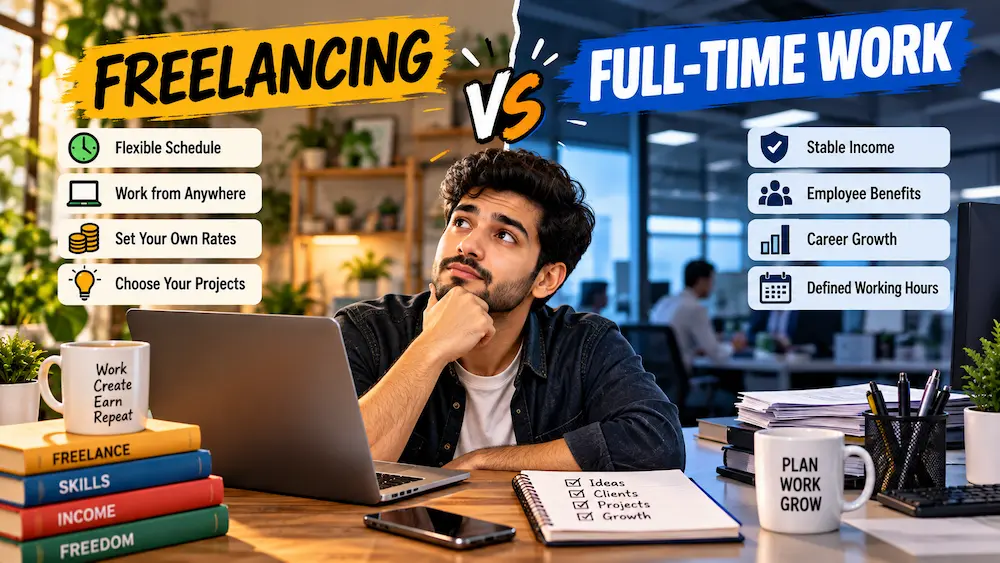
Freelancing vs Full-Time Work: Income, Freedom & Stability
Freelancing and full-time employment can both lead to a strong career, but they offer very different ways of working.
A full-time job usually gives you predictable pay, a defined role, regular working hours, and benefits provided by an employer. Freelancing gives you more control over your clients, workload, schedule, and rates, but it also makes you responsible for finding work and managing your own income.
Neither option is automatically better.
The right choice depends on how much you value stability, flexibility, earning potential, independence, and control over your time.
Freelancing vs Full-Time Work: The Main Difference
The biggest difference is who carries the responsibility.
In a full-time role, your employer usually provides the work, sets your responsibilities, pays you on a regular schedule, and handles many administrative tasks.
As a freelancer, you operate more like a small business. You may need to find clients, negotiate rates, write proposals, manage deadlines, send invoices, follow up on payments, and plan for periods when work is slow.
That extra responsibility can bring more freedom, but it also creates more uncertainty.
Quick Comparison
| Factor | Freelancing | Full-Time Work |
|---|---|---|
| Income | Can change month to month | Usually predictable |
| Schedule | Often flexible | Usually fixed |
| Job security | Depends on clients | Generally more stable |
| Benefits | Usually self-funded | May be employer-provided |
| Work choice | More control | Depends on employer |
| Income ceiling | Can rise with rates and clients | Often tied to salary structure |
| Administration | Managed by you | Mostly handled by employer |
| Career path | Self-directed | Often structured |
| Paid leave | Usually unpaid | May be included |
| Location freedom | Often greater | Depends on employer |
Income: Which One Pays More?
There is no universal winner.
A full-time employee normally knows what they will earn each month. That predictability makes it easier to plan rent, bills, savings, and other expenses.
Freelance income can be less predictable.
One month may be busy, while another may have fewer projects. A client can also reduce work or end a contract unexpectedly.
The advantage is that freelancers can often increase earnings by:
- raising their rates;
- working with better-paying clients;
- offering higher-value services;
- taking multiple clients;
- specializing in a valuable skill.
A salaried employee may also increase earnings through promotions, bonuses, job changes, and new qualifications.
The important difference is that freelancers usually have more control over pricing, while employees receive compensation within an employer’s pay structure.
Stability: Full-Time Work Usually Has the Advantage
For people who need dependable monthly income, full-time employment is often easier to manage.
A permanent role may provide:
- regular salary;
- predictable workload;
- paid leave;
- health or insurance benefits;
- retirement contributions;
- workplace protections;
- training.
The exact benefits vary by employer and country.
Freelancers usually have to create their own safety net.
That means keeping emergency savings, maintaining several client relationships, tracking future work, and avoiding dependence on a single client.
A freelancer with five steady clients may actually feel more secure than someone relying on one employer, but building that position takes time.
Freedom and Flexibility: Freelancing Usually Offers More Control
This is one of the main reasons people choose freelancing.
Depending on the work, freelancers may decide:
- which clients to accept;
- which projects to reject;
- when to work;
- where to work;
- how much to charge;
- which skills to develop.
That does not mean freelancers can simply work whenever they feel like it.
Clients still have deadlines, meetings, revisions, and expectations.
The difference is that freelancers often have more influence over how their working life is organized.
You can find more articles on work, publishing, and practical online skills on Uploadinsider.
Benefits and Expenses
A salary alone does not show the full value of a full-time job.
Suppose two people appear to earn the same annual amount. One is employed and the other is freelance.
The employee may also receive paid holidays, insurance, retirement contributions, equipment, software, training, and other benefits.
The freelancer may have to pay for those separately.
Freelancers should therefore think about their real hourly rate, not only what they charge a client.
Time spent on emails, proposals, accounting, marketing, revisions, and finding new work is still part of running a freelance business, even if nobody directly pays for those hours.
Career Growth Works Differently
Full-time careers often follow a visible route.
You may start in a junior position, gain experience, take on more responsibility, and move into senior or management roles.
You may also learn directly from colleagues and receive formal training.
Freelancers build careers differently.
Growth may mean:
- moving into a specialist niche;
- increasing rates;
- working with larger clients;
- building a small agency;
- creating products;
- becoming a consultant;
- reducing working hours while maintaining income.
Neither path guarantees progress.
Employees can remain stuck in the same role, and freelancers can remain stuck with low-paying clients.
Progress depends on skills, decisions, opportunities, and the quality of work you produce.
Work-Life Balance Can Be Good or Bad in Either Path
Freelancing is often marketed as complete freedom.
Reality is more complicated.
A freelancer with poor boundaries may work evenings and weekends because clients are spread across different time zones or because income feels uncertain.
A full-time employee may finish work at a fixed hour and completely disconnect.
The opposite can also happen.
A freelancer with established clients may work fewer hours, while an employee in a demanding role may regularly work overtime.
The employment type matters, but your workload and boundaries matter just as much.
Freelancing May Suit You If…
Freelancing may be a better fit if you:
- value control over your schedule;
- are comfortable finding clients;
- can handle uncertain income;
- communicate well;
- manage deadlines without close supervision;
- want control over your rates;
- prefer choosing your own projects;
- are willing to manage the business side of your work.
It also helps to have some savings before relying completely on freelance income.
Full-Time Work May Suit You If…
A full-time job may make more sense if you:
- want predictable income;
- value employer benefits;
- prefer a defined role;
- want regular interaction with a team;
- need financial stability;
- prefer not to find clients yourself;
- want structured career progression;
- learn better inside an organization.
There is nothing less ambitious about choosing stability.
For many people, a good full-time position gives them the financial and professional foundation they need.
You Can Also Combine Both
The choice does not always have to be permanent.
Some people keep a full-time job while freelancing part-time.
This allows them to test demand, build a portfolio, learn how clients work, and create savings before deciding whether to leave employment.
If you try this route, check your employment contract first. Some employers have rules about outside work, conflicts of interest, confidentiality, or working with competitors.
How to Decide
Instead of asking which option sounds more attractive, look at your actual situation.
Ask yourself:
How many months could I manage if freelance income dropped?
Do I already have a skill people pay for?
Am I comfortable selling my services and speaking with clients?
How important are employer benefits to me?
Do I want freedom badly enough to handle more responsibility?
Would I prefer one employer or several clients?
Your answers matter more than general claims that freelancing or employment is always better.
Freelancing vs Full-Time: Which Should You Choose?
Choose freelancing if you want greater control over clients, schedule, pricing, and the direction of your work—and you can tolerate income that may change from month to month.
Choose full-time employment if dependable pay, benefits, structure, and a clearer career path matter more to you.
And if you are unsure, you do not need to make an immediate jump.
Building freelance work beside a job can give you real experience before you make a larger decision.
The better option is the one that fits your financial needs, working style, responsibilities, and long-term goals.